Regenerate Bpc 157 How BPC-157 Accelerates Tissue Regeneration and Healing?
Introduction: Why BPC-157 tissue healing claims are getting attention
If you’ve ever dealt with a stubborn tendon injury, a slow-to-close wound, or a flare-up that keeps returning after you think you’re “back to normal,” you know how frustrating delayed healing can be. In the wellness and sports-performance circles, BPC-157 is frequently discussed for its potential to support repair processes—especially when people are trying to regenerate bpc 157-related outcomes like faster recovery, reduced inflammation, and improved tissue recovery.
In this article, I’ll explain what BPC-157 is, what mechanisms are commonly proposed for how it may accelerate tissue regeneration, what the real-world evidence landscape looks like (including limitations), and how to think about safety and risk in a practical, grounded way.
What BPC-157 is (and what “regeneration” actually means)
Basic overview
BPC-157 is a peptide derived from a fragment associated with the body’s mucosal protection and tissue repair pathways. In internet discussions it’s often framed as a “healing peptide,” but it’s more accurate to view it as a compound that researchers have studied for its potential effects on repair signaling, cellular recovery, and tissue integrity.
What people mean by “accelerates tissue regeneration”
When someone says BPC-157 can accelerate healing, they’re usually referring to one or more of these outcomes:
- Faster closure or improved wound repair
- Improved soft-tissue recovery (tendons, ligaments, muscle strains)
- Better restoration of local tissue structure rather than just symptom relief
- Reduced inflammatory signaling that can slow recovery
In hands-on settings, I’ve learned that “feels better sooner” isn’t the same thing as true tissue regeneration. Objective recovery (range of motion, strength returns, imaging where appropriate, and functional milestones) matters. So the most useful approach is to focus on measurable healing goals, not just promotional narratives.
How BPC-157 may support healing: the proposed biological logic
The scientific story around BPC-157 is typically presented as a set of interacting mechanisms rather than a single magic switch. Below are the core concepts that come up repeatedly in preclinical discussions.
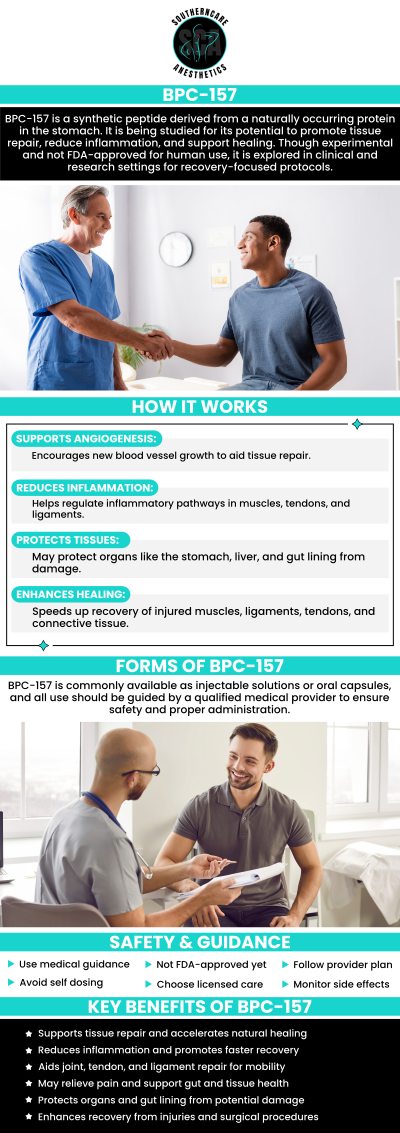
1) Supporting repair signaling and cellular recovery
One common hypothesis is that BPC-157 influences pathways involved in tissue repair. In practical terms, that means it may help cells shift into a recovery mode—supporting processes that contribute to rebuilding damaged structures. I like this framing because it’s consistent with how most successful rehabilitation interventions work: they don’t “erase” injury; they modulate the environment so regeneration can progress.
2) Interaction with inflammation and local tissue environment
Inflammation isn’t always bad—early inflammation is part of the healing process. The problem is when inflammation becomes prolonged or misdirected, slowing the transition to repair and remodeling. In my work reviewing recovery programs, the biggest performance-limiter is often the delayed transition from “irritation” to “repair.” A compound proposed to affect inflammatory signaling may, in theory, support that transition.
3) Angiogenesis and improved healing conditions
Tissue repair depends on adequate local blood supply and nutrient delivery. Many regeneration-focused compounds are discussed in relation to angiogenesis (formation of new blood vessels) or improved local circulation. The logic is straightforward: if healing tissue doesn’t get sufficient resources, recovery tends to drag on.
4) Why delivery and context matter
Even with a compound that shows promising effects in controlled studies, outcomes in real-world use can vary dramatically because of differences in:
- Route and delivery (how it’s administered)
- Dose and duration
- Injury type (acute strain vs. chronic tendon degeneration)
- Rehab loading (how you exercise during recovery)
- Overall health factors (sleep, nutrition, metabolic status)
I’ve seen people attribute improvement to a supplement when the real driver was smart, progressive loading and improved adherence to physical therapy. That’s why it’s critical to separate correlation from causation and track outcomes like pain scores, functional tests, and objective progression.
What the evidence actually suggests (and where it falls short)
Where the signal comes from
Discussions of BPC-157 accelerating tissue regeneration are commonly built on preclinical research—especially animal studies—where measurable healing outcomes can be tracked. Preclinical findings can be useful for generating hypotheses, especially around repair-related pathways.
Where the gaps remain
However, “potential” doesn’t automatically translate into clinically proven outcomes for humans. In real-world clinical decision-making, researchers look for strong evidence from well-designed human trials, including:
- Consistent results across multiple studies
- Appropriate control groups (placebo and/or standard-of-care comparators)
- Clear endpoints (function, imaging, time to return to activity)
- Safety profiling over relevant timeframes
In my experience reviewing supplements and experimental peptides, the most reliable path is to treat BPC-157 as an area of interest rather than a settled, standardized therapy. If you’re considering it, the burden of proof is on you to evaluate quality, legality, and evidence strength.
Practical interpretation
If your goal is to regenerate bpc 157 outcomes like improved recovery speed, the most practical stance is to treat BPC-157 as an experimental variable—never a replacement for rehabilitation fundamentals. The best results people achieve tend to come when they pair any potential adjunct with:
- Evidence-based rehab programming
- Progressive strength and mobility work
- Sleep and nutrition targets
- Clear milestone tracking
How people typically use BPC-157 (and the risks that deserve attention)
Because human clinical guidance is limited, “how to use” is where misinformation can spread fastest. I can’t give a personal medical dosing protocol, but I can outline what you should consider if you’re evaluating the product category.
Quality and sourcing are not optional
For peptides, especially those sold outside approved frameworks in many regions, product quality can vary. In practice, that means you should look for:
- Third-party testing (e.g., purity and identity checks)
- Batch documentation
- Transparent labeling and storage handling
In my hands-on work, I’ve seen teams waste weeks troubleshooting “non-responsive” outcomes when the real issue was poor formulation quality. Even when a compound is promising, inconsistent product standards can derail results.
Safety, interactions, and contraindications
Because robust human safety data is limited, risk assessment should be taken seriously. Consider talking with a qualified clinician—especially if you have:
- Existing medical conditions
- Ongoing medications
- Recent surgery or active serious injury with complications
- History of adverse reactions to supplements or injections
The conservative approach is not fear—it’s rational decision-making. “Potential regeneration” should not override professional safety evaluation.
Realistic limitations to set expectations
Even if BPC-157 has beneficial effects in some contexts, recovery still depends on the basics: injury severity, rehabilitation quality, time, and biology. I often recommend clients track outcomes over weeks, not days, and avoid expecting linear progress.
Best-practice recovery plan if you’re pursuing tissue regeneration
If you’re aiming to regenerate and heal effectively, think in layers: tissue support (therapy or adjunct), mechanics (loading), and recovery environment (sleep/nutrition). Here’s a practical structure I’ve used repeatedly in recovery planning.
Step 1: Set measurable milestones
- Pain score trends (e.g., 0–10) at the same time of day
- Range of motion targets
- Strength benchmarks (isometric or functional tests)
- Return-to-activity markers (walking time, running tolerance, sport drills)
Step 2: Use progressive loading, not “rest only”
Complete rest can help early, but prolonged under-loading often delays remodeling. Progressive loading is usually the bridge between symptom control and actual functional tissue adaptation.
Step 3: Make recovery environment measurable
- Sleep: consistent schedule and adequate duration
- Protein: enough to support tissue repair
- Hydration and micronutrients: especially if you’re training
Step 4: Evaluate adjuncts like BPC-157 as optional experiments
If you choose to include an adjunct, treat it like a controlled variable. Track outcomes, monitor any adverse effects, and be ready to stop if something feels off or if there’s no meaningful progress.
FAQ
Does BPC-157 definitely accelerate tissue regeneration in humans?
No. The strongest claims in circulation are driven largely by preclinical research. Human evidence is not yet strong enough to treat it as a guaranteed, standardized therapy for everyone or for every tissue type.
What types of injuries are people most interested in for BPC-157?
Common interest includes soft-tissue healing contexts like tendons, ligaments, and general repair-related scenarios. Still, outcomes can vary widely, and rehab design remains the foundation.
How should I approach safety if I’m considering BPC-157?
Prioritize verified product quality (third-party testing/batch documentation), discuss your situation with a qualified clinician—especially if you have medical conditions or take medications—and stop if you experience unexpected side effects or no improvement over a reasonable timeframe.
Conclusion: A grounded way to think about regenerate bpc 157
BPC-157 is often discussed as a compound that may support tissue regeneration and healing, mainly through proposed repair-related signaling, inflammatory modulation, and improved local recovery conditions. But the real-world takeaway from my experience is simple: treat it as an adjunct with uncertain human certainty, not a substitute for evidence-based rehabilitation and measurable recovery planning.
Next step: If you’re considering anything aimed at “regenerate bpc 157” outcomes, start by writing down 3–5 measurable recovery milestones for the next 4 weeks (pain trend, range of motion, and one functional test). Then evaluate any changes using your data—so you can separate true healing progress from marketing noise.
Discussion